



A new hire’s first week genuinely shapes how they feel about a job for a lot longer than that single week actually lasts – and spending it chasing missing paperwork, waiting around for system access, or filling out the same form for a third time isn’t the impression most Sri Lankan businesses are actually trying to make on someone they just spent time and effort recruiting.
First impressions in employment work much like they do anywhere else – disproportionately powerful relative to how much time they actually take, and genuinely difficult to fully undo once a new hire’s initial perception has already formed.
Why This Matters for Sri Lankan Businesses
Onboarding is also where a significant amount of compliance-relevant documentation typically gets collected – identification documents, bank details needed for EPF/ETF setup, signed policy acknowledgements – and a disorganized process at this specific stage creates gaps that inevitably surface later, usually at the least convenient possible time, such as during a first payroll run with genuinely missing bank details.
There’s also a measurable productivity cost to slow onboarding beyond just the new hire’s personal experience. Every day a new employee spends without proper system access or a clear understanding of their role and responsibilities is a day of reduced productivity that a more structured, faster process would have avoided entirely.
A Familiar Scenario
A growing fintech startup in Colombo currently onboards new hires through a mix of PDF forms emailed back and forth, a verbal policy briefing that varies noticeably depending on who happens to be delivering it that week, and IT account setup requested through a completely separate ticketing system that sometimes takes several days to actually be actioned. New hires have specifically mentioned, in exit interviews from previous roles elsewhere, just how disorganized a first week can genuinely feel.
Common Challenges Without the Right System
- Onboarding documents collected via scattered email attachments, with no central, reliable tracking of what’s actually been received
- Policy briefings delivered quite inconsistently, depending heavily on who happens to be conducting the onboarding that particular week
- Account and system access requested through an entirely separate process, often causing real delays during a new hire’s critical first days
- No clear visibility into overall onboarding status for HR teams managing multiple new hires simultaneously
- Missing critical details – like bank information needed for EPF/ETF – not caught until the very first payroll run is already underway
- New hires unclear on exactly what’s expected of them or who to approach with questions during their initial days
What to Look For
- Digital document collection and verification, entirely replacing scattered, hard-to-track email attachments
- New hires set up automatically with the correct role, department and system access from day one
- Consistent policy sharing and formal acknowledgement, regardless of who happens to be managing the onboarding that week
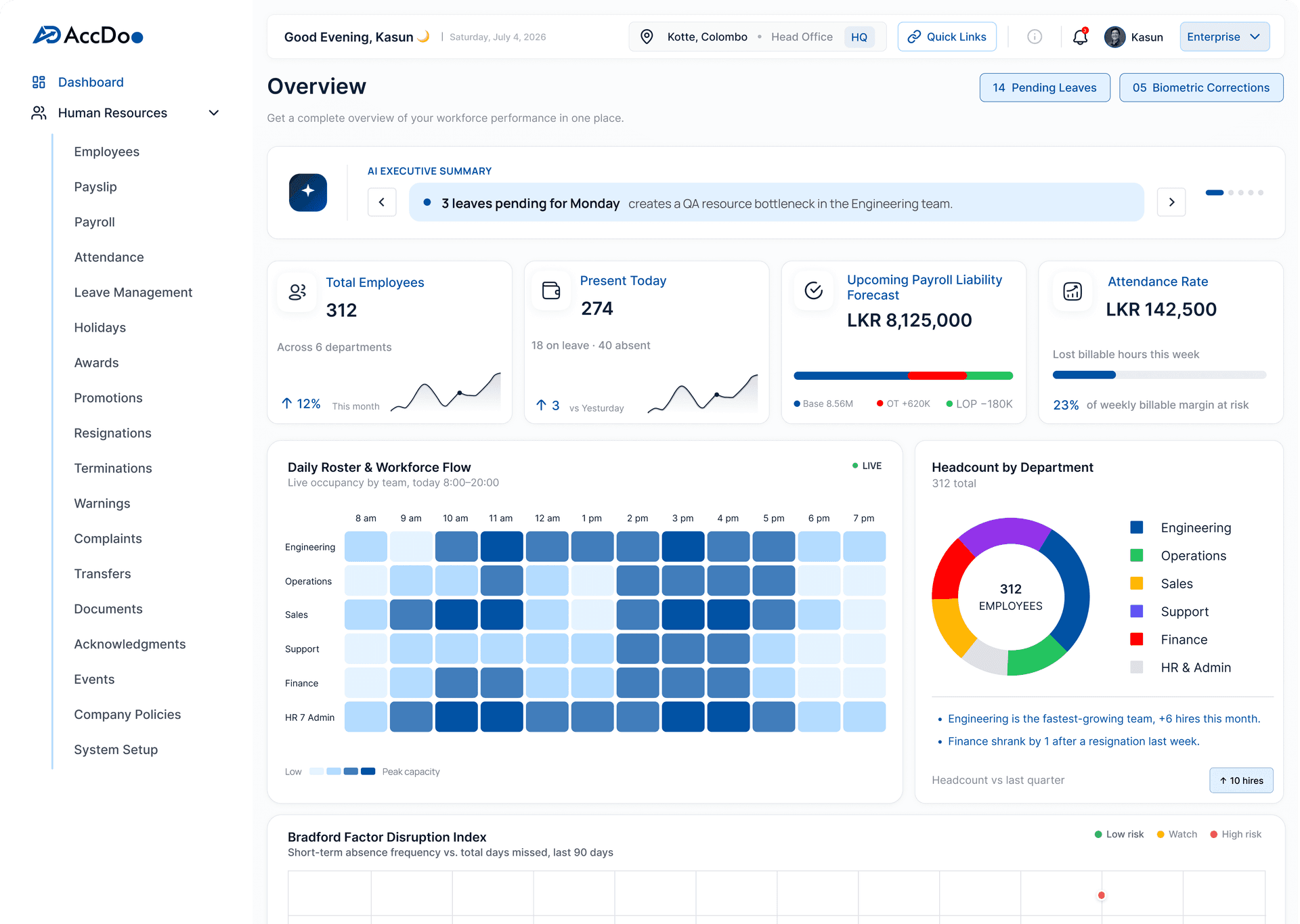
- Onboarding status visible to HR across every new hire currently being processed, all in one dashboard
- Details required for payroll setup captured upfront during onboarding, well before the first pay cycle begins
- A clear, structured checklist that gives new hires visibility into their own onboarding progress
How AccDoo Handles This
AccDoo HRMS handles onboarding as a single guided digital flow – documents collected and verified in one central place, policies shared consistently regardless of who’s specifically running the process that week, and role or department access configured as a natural part of the same setup rather than a completely separate IT ticket request.
Because onboarding and payroll live within the same connected system, the bank and personal details needed for a smooth first payroll run are captured upfront as a natural part of the onboarding flow itself, rather than being discovered as missing only after the first pay cycle is already actively underway.
Sri Lankan Market Context
Sri Lanka’s competitive job market, particularly in IT, BPO and financial services, means candidates frequently have multiple active offers to weigh against each other – and a disorganized, clearly unpolished onboarding experience can genuinely undermine confidence in an otherwise strong offer, right at the exact moment a new hire is still forming their overall impression of the company they’ve chosen to join.
For businesses hiring across multiple locations simultaneously, consistent onboarding also matters for maintaining company culture as the organization scales – a structured process ensures every new hire, regardless of which branch or department they’re joining, receives the same core information and genuinely feels equally welcomed and prepared from their very first day.
Who This Is Built For
Any Sri Lankan business hiring regularly enough that onboarding consistency has become a genuine, recognized concern – particularly growing companies where the process currently varies noticeably depending on who happens to be handling it week to week.
Getting Set Up
Configuring onboarding involves defining the standard document checklist, policy set, and role-based access templates the business uses for new hires. Once set up, each new hire follows the same guided flow, with HR able to track progress across everyone currently being onboarded.
Frequently Asked Questions
Can onboarding documents be collected and verified digitally? Yes – new hires submit required documents digitally, with HR able to track and verify exactly what’s been received, all in one central place.
Does onboarding connect directly to payroll setup? Yes – details needed for the first payroll run, including bank information for EPF/ETF, are captured as a natural part of the onboarding flow itself.
Can HR track onboarding status for multiple new hires at once? Yes – a dashboard view shows onboarding progress across every new hire currently being processed simultaneously.
Can onboarding checklists be customized for different roles or departments? Yes – document and access requirements can vary by role or department while still following the same overall consistent process.
Can a new hire start filling in some onboarding details before their official start date? Yes – onboarding can begin as soon as an offer is accepted, letting a new hire submit documents and details ahead of day one so their first morning isn’t spent on paperwork.
Getting Started
A disorganized first week costs more than it might initially look like – both in real HR hours spent and in how a new hire ultimately feels about the job they just accepted. Explore Onboarding Software or book a demo to see the guided flow directly.