

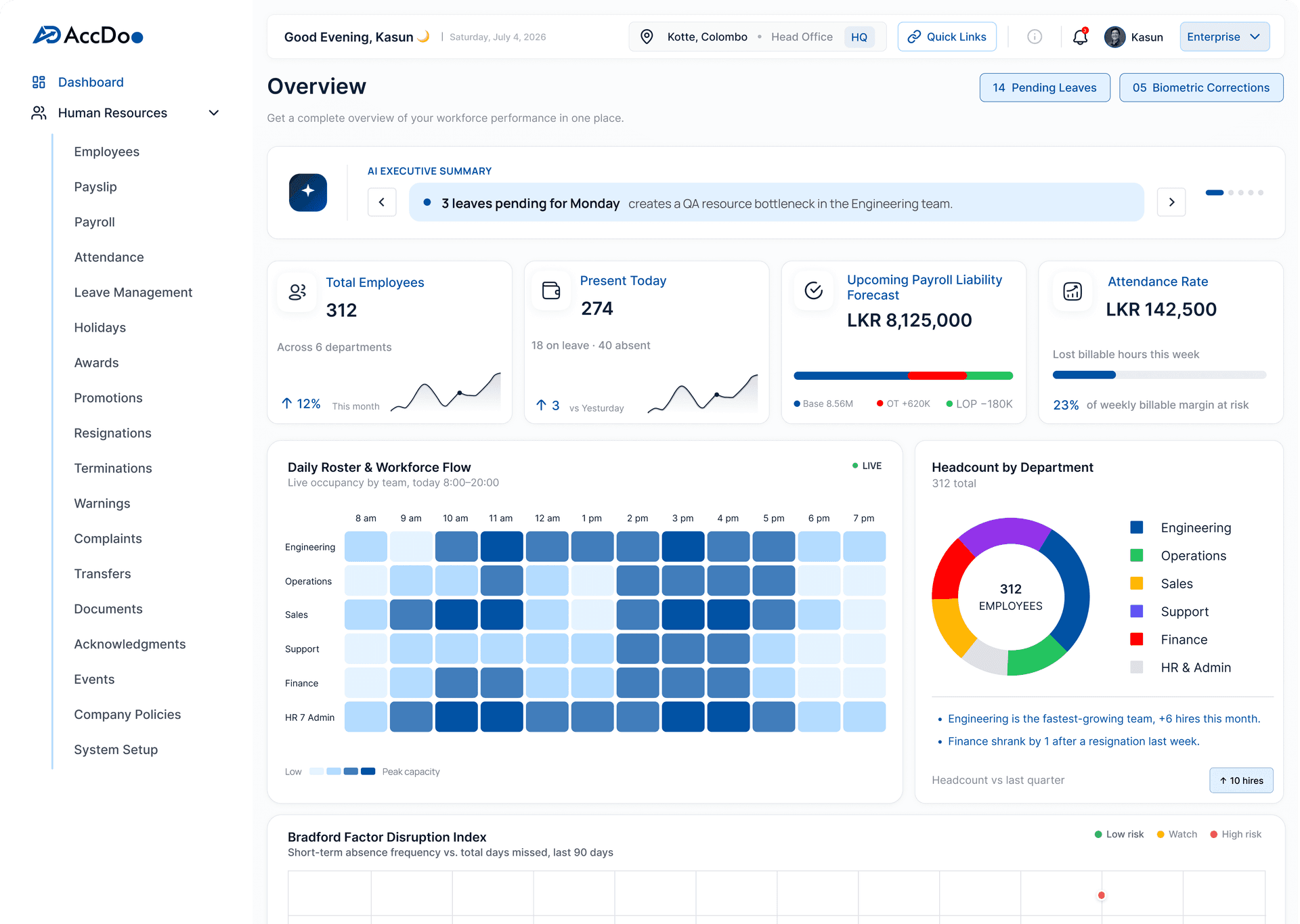


An HR team that can’t answer “what’s our total payroll cost trending this quarter” or “which department has the highest overtime spend” without a multi-day data-gathering exercise is, in effect, managing the business’s largest expense category – people – with less visibility than most businesses have into a single product line.
AccDoo’s HR Reports & Analytics module is built to close that gap: real-time reports and dashboards drawing directly on the same employee, attendance, leave and payroll data used across every other HRMS module, plus AI-powered insights that answer a specific question directly rather than requiring a custom report built from scratch.
Why This Matters for Sri Lankan Businesses
HR reporting in a disconnected setup usually means exporting data from a payroll system, cross-referencing it against a separate attendance spreadsheet, and manually assembling whatever specific view a manager has asked for – a process that takes real time and tends to only happen when someone specifically requests it, rather than being available on demand.
That reactive pattern means genuinely useful trends – a department’s overtime cost climbing steadily over several months, an unusual spike in leave requests around a specific time of year – often go unnoticed simply because nobody happened to ask the right question at the right time, not because the data wasn’t there.
A Day in the Life
An HR manager at a manufacturing business in Katunayake wants to understand whether overtime costs are trending upward before presenting next quarter’s budget to leadership. Getting that answer currently means requesting a payroll export from finance, cross-referencing it against attendance records for the same period, and manually building a trend view in a spreadsheet – a task that takes the better part of a day and only gets done because a specific presentation deadline forced it.
With AccDoo’s HR Reports & Analytics, that same manager pulls up a live overtime trend dashboard directly, or asks the AI agent “has overtime cost increased over the last three months” and gets a direct, data-backed answer immediately – not because a presentation deadline forced the exercise, but because checking is now fast enough to do routinely, catching a concerning trend months before it would otherwise surface.
What’s Included
- HR reports – headcount, turnover, department composition and demographic breakdowns generated on demand
- Payroll reports – total payroll cost, EPF/ETF/APIT contribution summaries and department-level cost breakdowns
- Deduction reports – a clear breakdown of every deduction type applied across the workforce, by employee or in aggregate
- Custom reports – saved, reusable views built around a business’s own recurring HR questions
- AI-powered HR insights – plain-language questions about workforce data answered directly, the same underlying capability used across AccDoo’s broader AI Agent
Setting This Up
HR Reports & Analytics doesn’t require separate setup – reports and dashboards become available automatically once Employee Management, Attendance and Payroll are in active use, since every report here is a live view into that same underlying data rather than a separately maintained dataset.
Custom reports and saved dashboard views are worth configuring around the specific questions a business’s leadership actually asks regularly – a quarterly overtime trend, a department headcount summary – so those become one-click views rather than rebuilt manually each time the same recurring question comes up.
What to Watch For
A common mistake is building an initial dashboard with every metric available rather than the handful that actually matter for regular decision-making – a dashboard crowded with dozens of secondary metrics gets checked less often than a focused one showing the three or four numbers a manager genuinely needs to see first thing each week.
Another is not actually training managers to ask the AI-powered insights feature specific questions, defaulting instead to only using pre-built standard reports out of unfamiliarity. The standard reports cover routine needs well, but the real time savings tend to show up when a manager gets comfortable asking a genuinely specific, ad hoc question rather than only viewing what’s already been pre-built.
Real Numbers, Not Guesses
An HR team manually assembling a quarterly workforce report – headcount trends, overtime costs, departmental breakdowns – for a leadership presentation commonly spends one to two full days on data gathering and assembly, particularly if the request comes with limited notice.
The same report, generated directly from live, connected data, typically takes minutes rather than days – freeing that reclaimed time for actually analyzing what the trend means and preparing recommendations, rather than spending the bulk of the available time simply assembling the underlying numbers in the first place. For an HR team preparing several such reports a year – quarterly reviews, an annual budget cycle, ad hoc leadership requests – that reclaimed time can add up to a genuinely significant share of the team’s total annual capacity.
Making the Switch
There’s no migration required specifically for reporting – once Employee Management, Attendance and Payroll data exists in AccDoo, historical reports going back to that data’s start date are available immediately, without a separate reporting-specific setup process.
For businesses wanting to compare against pre-AccDoo historical trends, keeping a static export of the old system’s final reports as a reference point is useful, since ongoing comparative trend analysis going forward will be based on the new, connected data rather than needing to reconcile two different reporting systems’ historical outputs.
Questions Sri Lankan Buyers Actually Ask
Do HR reports update in real time, or only after a manual refresh? Reports reflect the current state of employee, attendance and payroll data, updating as that underlying data changes rather than requiring a manual refresh step
Can I ask a specific question about workforce data instead of building a report? Yes – AI-powered HR insights answer plain-language questions directly from your own workforce data, without needing a custom report built first.
Can I see payroll cost broken down by department? Yes – payroll reports can be broken down by department, role or individual employee, depending on the level of detail needed.
Can a saved report be shared with someone who doesn’t otherwise have HRMS access? Reports can be exported for sharing outside the platform, such as with a board member or external auditor who doesn’t need ongoing system access.
Does this replace the need for an HR manager to interpret the data? No – it removes the manual work of assembling the data, freeing time for the actual interpretation and decision-making that requires human judgment.
Can I compare workforce metrics across multiple branches or locations? Yes – reports can be viewed at the individual branch level or consolidated across every location for a company-wide picture.
Is historical data retained for year-over-year comparison? Yes – historical HR and payroll data is retained, making it straightforward to compare a metric like turnover or overtime cost against the same period in a previous year.
Can reports flag anomalies automatically, rather than requiring someone to spot them manually? Yes – AI-powered insights can flag unusual patterns, such as a sudden overtime spike in one department, without requiring someone to manually review every report line by line.
How This Fits the Full AccDoo Platform
HR Reports & Analytics is a live view into the same Employee Management, Attendance, Leave and Payroll data used across the rest of AccDoo HRMS – and because HRMS and ERP share the same underlying platform, total staffing cost from these HR reports can sit directly alongside every other business expense in AccDoo’s broader financial reporting, giving leadership one connected view of the business rather than an HR report and a financial report that need manual reconciling against each other afterward. That same connection means a question spanning both sides of the business – “how does total staffing cost compare to revenue growth this quarter” – can be answered directly, rather than requiring someone to manually combine an HR report and a financial report that were never designed to be compared against each other in the first place.
Sri Lankan Market Context
Sri Lankan HR teams have historically had less access to sophisticated reporting tools than their finance counterparts, often because HR software adoption has lagged behind accounting software adoption at the SME level – meaning HR decisions are frequently made with less real-time data backing them than equivalent financial decisions in the same business.
As Sri Lankan businesses increasingly compete for skilled talent, HR analytics – turnover trends, overtime patterns, departmental cost efficiency – has become a genuine strategic input, not just an administrative record-keeping exercise, making real-time access to this data a competitive factor rather than a nice-to-have reporting convenience. A business that can show a prospective senior hire a genuinely data-informed approach to workforce planning is making a different kind of impression than one still assembling its numbers manually the week before a board meeting.
Who This Is Built For
HR managers, finance leads and business owners in Sri Lanka who currently assemble workforce reports manually, or who’ve learned not to ask a specific HR question because getting a real answer has historically taken too long to be worth the effort.
The Bigger Picture
Consider a specific recurring scenario: an annual budget planning cycle where leadership wants to understand true staffing cost trends before setting next year’s targets. A business relying on manual report assembly typically starts that analysis under real time pressure, with data quality depending on whoever happened to have time to pull it together. A business with real-time HR analytics starts that same conversation already knowing the trend, spending the actual planning time on decisions rather than data-gathering.
There’s also a retention angle worth naming: HR analytics that surface an early warning sign – a specific department’s overtime creeping up, a spike in leave requests that might signal burnout – give a business the chance to intervene before that trend turns into an actual resignation. Catching a retention risk three months earlier through visible data, rather than being surprised by an exit interview, is a meaningfully different position to manage from. Multiplied across a full year and a workforce of any real size, even a modest improvement in early-warning visibility can mean the difference between replacing a handful of key staff unexpectedly and retaining them through a timely, informed conversation.
Getting Started
Explore Payroll Software or the AccDoo AI Agent above to see the underlying data this reporting layer draws on, or book a demo to see a real HR question answered directly from live workforce data.